Daniel Purposed in His Heart
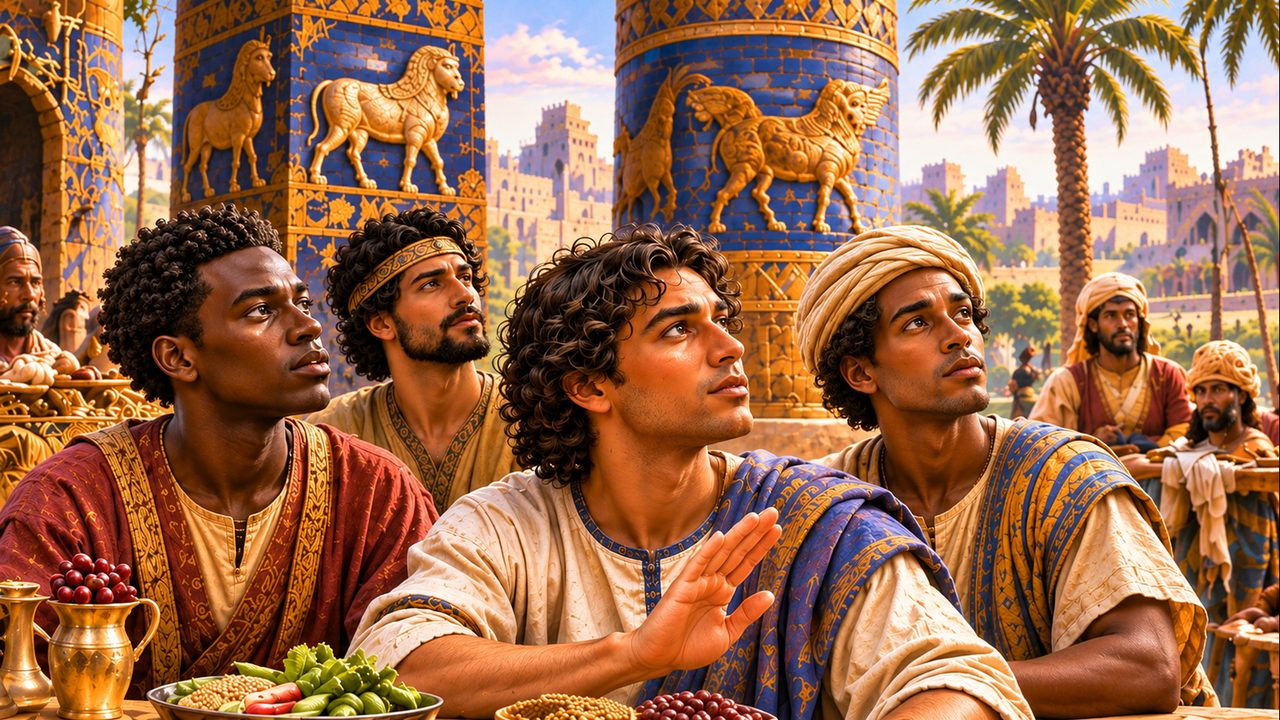
God of Daniel, as we begin this book of faithfulness and prophecy, give us hearts that purpose to be true to You. Teach us through the lives of these young captives how to stand for You today. Amen.
Opening hymn
Sing along with Melissa Oretade on YouTube ↗
Scripture reading: Daniel 1 (KJV)
1In the third year of the reign of Jehoiakim king of Judah came Nebuchadnezzar king of Babylon unto Jerusalem, and besieged it. 2And the Lord gave Jehoiakim king of Judah into his hand, with part of the vessels of the house of God: which he carried into the land of Shinar to the house of his god; and he brought the vessels into the treasure house of his god. 3And the king spake unto Ashpenaz the master of his eunuchs, that he should bring certain of the children of Israel, and of the king's seed, and of the princes; 4Children in whom was no blemish, but well favoured, and skilful in all wisdom, and cunning in knowledge, and understanding science, and such as had ability in them to stand in the king's palace, and whom they might teach the learning and the tongue of the Chaldeans. 5And the king appointed them a daily provision of the king's meat, and of the wine which he drank: so nourishing them three years, that at the end thereof they might stand before the king. 6Now among these were of the children of Judah, Daniel, Hananiah, Mishael, and Azariah: 7Unto whom the prince of the eunuchs gave names: for he gave unto Daniel the name of Belteshazzar; and to Hananiah, of Shadrach; and to Mishael, of Meshach; and to Azariah, of Abednego. 8But Daniel purposed in his heart that he would not defile himself with the portion of the king's meat, nor with the wine which he drank: therefore he requested of the prince of the eunuchs that he might not defile himself. 9Now God had brought Daniel into favour and tender love with the prince of the eunuchs. 10And the prince of the eunuchs said unto Daniel, I fear my lord the king, who hath appointed your meat and your drink: for why should he see your faces worse liking than the children which are of your sort? then shall ye make me endanger my head to the king. 11Then said Daniel to Melzar, whom the prince of the eunuchs had set over Daniel, Hananiah, Mishael, and Azariah, 12Prove thy servants, I beseech thee, ten days; and let them give us pulse to eat, and water to drink. 13Then let our countenances be looked upon before thee, and the countenance of the children that eat of the portion of the king's meat: and as thou seest, deal with thy servants. 14So he consented to them in this matter, and proved them ten days. 15And at the end of ten days their countenances appeared fairer and fatter in flesh than all the children which did eat the portion of the king's meat. 16Thus Melzar took away the portion of their meat, and the wine that they should drink; and gave them pulse. 17As for these four children, God gave them knowledge and skill in all learning and wisdom: and Daniel had understanding in all visions and dreams. 18Now at the end of the days that the king had said he should bring them in, then the prince of the eunuchs brought them in before Nebuchadnezzar. 19And the king communed with them; and among them all was found none like Daniel, Hananiah, Mishael, and Azariah: therefore stood they before the king. 20And in all matters of wisdom and understanding, that the king enquired of them, he found them ten times better than all the magicians and astrologers that were in all his realm. 21And Daniel continued even unto the first year of king Cyrus.
Commentary
It could not have been an easy decision. Daniel and his three friends were young captives, carried far from home to the capital of the most powerful empire on earth. They were chosen for the king’s own training program, given new names, and offered food from the royal table. To refuse the generous hospitality of the king of Babylon was a dangerous thing to do.
“But Daniel purposed in his heart that he would not defile himself with the portion of the king’s meat, nor with the wine which he drank” (Daniel 1:8). He asked instead for a simple diet of vegetables and water. Daniel and his friends were willing to sacrifice honor, wealth, position, and power, even life itself, for the God whom they loved more than anything else.
At the end of their training, the king examined them, and “in all matters of wisdom and understanding, that the king enquired of them, he found them ten times better than all the magicians and astrologers that were in all his realm” (v. 20). Why were they so successful? Was it luck or chance? It was not even a miracle in the usual sense. Here is the key to their success:
First, they made a firm commitment to remain faithful to God. Their resolve was more than an intention: relying on His strength, they put it into practice.
Second, they depended fully on God’s power. They prayed for His help, trusted Him to provide it, and studied diligently to bring Him glory. Their faith did not replace effort; it gave their effort purpose.
Third, they chose carefully what they ate and drank. They refused anything that would harm their health or cloud their minds, protecting their ability to think clearly and serve God faithfully.
Daniel’s example is not confined to a distant time and place. We too can choose to trust God, obey His Word, and remain faithful in our daily decisions. What gives us the desire to be loyal to Him? The nail prints in Jesus’ hands—the reminder of His love for us. Our obedience is a response to that love.
Summarized from the commentary by Cindy Tutsch. Read the original ↗
Reflection from the discussion: Ambassadors in Captivity
Daniel was probably still a teenager when he was taken captive to Babylon. Look at what the Babylonians tried to do to these young men. They tried to change their thinking with a Babylonian education, “the learning and the tongue of the Chaldeans” (v. 4). They tried to change their loyalty by changing their names: Daniel (“God is my judge”) became Belteshazzar, honoring a Babylonian god, and Hananiah, Mishael, and Azariah became Shadrach, Meshach, and Abednego (v. 7). And they tried to change their lifestyle by changing their diet. Language is closely tied to character and culture. By remaking these four bright young captives, Babylon hoped to remake the faith of the whole captive people through them. The enemy has used the same strategy ever since: change what people think, whom they serve, and how they live, and you will change who they are.
Daniel could not control his education, his name, or his address. But he could control his heart. “Daniel purposed in his heart.” That was the turning point of his whole life. And notice how he carried out his purpose. Without compromising, he found a way to live by God’s standards in a culture that did not honor God. Wisely choosing to negotiate rather than rebel, he respectfully asked the official, “Prove thy servants, I beseech thee, ten days” (v. 12). Many believers stand firm on principle but forget the second part, courtesy and tact, and so leave a harsh impression of what true Christianity is. Our witness to unbelievers should be genuine, without placing stumbling blocks of our own making in their path.
Daniel’s resolve also rested on God’s Word. The law of Moses had spelled out what would defile God’s people, and Daniel took it seriously even in a foreign land, where no one from home would ever know what he ate. Faithfulness in small things, in private places, prepares us for faithfulness in great things.
We are God’s ambassadors, even in captivity. An ambassador carries the standards of his homeland wherever he goes. Many young people today find themselves in a situation much like Daniel’s when they attend public universities or enter demanding workplaces. They are exposed to teachings that contradict God’s Word and pressures that challenge their faith. One grandmother shared that she often tells her granddaughter, a student at a university with many students of other faiths, to “be who He has called you to be.” By God’s grace, and the faithful teaching of her mother from childhood, the young woman is standing as a witness for Him. Let us pray for all our young people who face their own Babylons.
The pressure to conform must have been great. But there may come a time in each of our lives when we have to decide to stand for what we know to be true, no matter the cost: the loss of friends, of job opportunities, even of the approval of family and fellow believers. May we be brave enough to stand.
God honored their choice. “As for these four children, God gave them knowledge and skill in all learning and wisdom: and Daniel had understanding in all visions and dreams” (v. 17). The fear of the Lord is the beginning of wisdom, and God rewards His faithful children. Many who have tried a simple “Daniel fast” of plain food, combined with extra time in prayer and Bible study, testify that they found clearer minds and closer fellowship with God than they thought possible. Eating as God intended clears the mind; time in His Word gives it something worth remembering.
The choices we make today, in what we eat and drink, in our attitude toward God and toward others, will make a difference in whether we stand for God when the great test comes. We are living in critical times. God is preparing a people for the final crisis. Daniel and his friends trusted God above all, risking even their lives to honor the God they had been taught to worship from childhood, and God used them to witness to a whole heathen empire.
An old gospel song by Philip P. Bliss puts it simply: “Dare to be a Daniel, dare to stand alone! Dare to have a purpose firm! Dare to make it known.” And even if we stand alone, we know that we never truly stand alone, for He is always with us.
Drawn from the reader discussion on Daniel 1, with insights from Ros Farrell, David Nino, Charock01, Emmanuel Moyo, Ron Koenig, Beverley Joseph, PNB, Pauline NS, SimplyTriniSabbieSimplyMe, Tiligi, Ruth. m.h., charityfirst, Robert Ombori, Prof Abiodun Adesegun and Ezekiel Adelere Adeniran.
What is one area of your life where the world is trying to change your thinking, your loyalty, or your lifestyle? What would it look like for you to “purpose in your heart” to stay true to God there, with both firmness and courtesy?
Lord, give us the purpose of Daniel. Help us stay faithful in small things and great, in private and in public. Give us wisdom to stand for You with courage and courtesy, protect our young people in their Babylons, and make us faithful ambassadors of Your kingdom. Amen.